

Welcome Email Series for Publishers: What to Send and When
UniSignIn Team
4 min read



A reader who has just created an account is as interested in you as they will ever be. They chose to give you their email address a moment ago. What happens in the next two weeks decides whether that account becomes a habit or a forgotten login.
Most publishers send one confirmation email and then add the reader to the weekly newsletter. A welcome email series does more: a short sequence of emails, each with one job, that introduces your best content and asks for one small next step at a time.
Why a Series Instead of One Email
A single welcome email has to do everything at once: say thank you, explain the newsletters, promote the app, mention the subscription. Readers skim it and remember none of it.
A series spreads that out. Each email is short and asks for one thing. And because the emails are sent over days, you can react to what the reader did: someone who opened the first email and clicked through to three articles needs a different second email from someone who never opened it.
Welcome emails are also the most opened emails most publishers send. New readers expect them and look for them, so they are the best place to set expectations for everything you send later.
A Four-Email Welcome Series
Email 1: Welcome, sent immediately. Thank the reader, confirm what they signed up for, and link to three of your best recent stories. Keep it short. If registration unlocked something, such as more free articles or comments, say so here.
Email 2: Your newsletters, two days later. Show the newsletters you offer, with one line on each and how often it arrives. Let readers choose. A reader who picks two newsletters they want is worth more than one who is subscribed to everything and ignores it all.
Email 3: Make it yours, five days in. Ask the reader to follow the topics or writers they care about, or to set their preferences in their account. Every choice they make improves what you can send them and show them on your site.
Email 4: The next step, ten to fourteen days in. Now ask for something bigger: a paid subscription, the app, a membership. By this point the reader has had two weeks of your content. Lead with what they get, not with the price.
Follow Up with Readers Who Stay Quiet
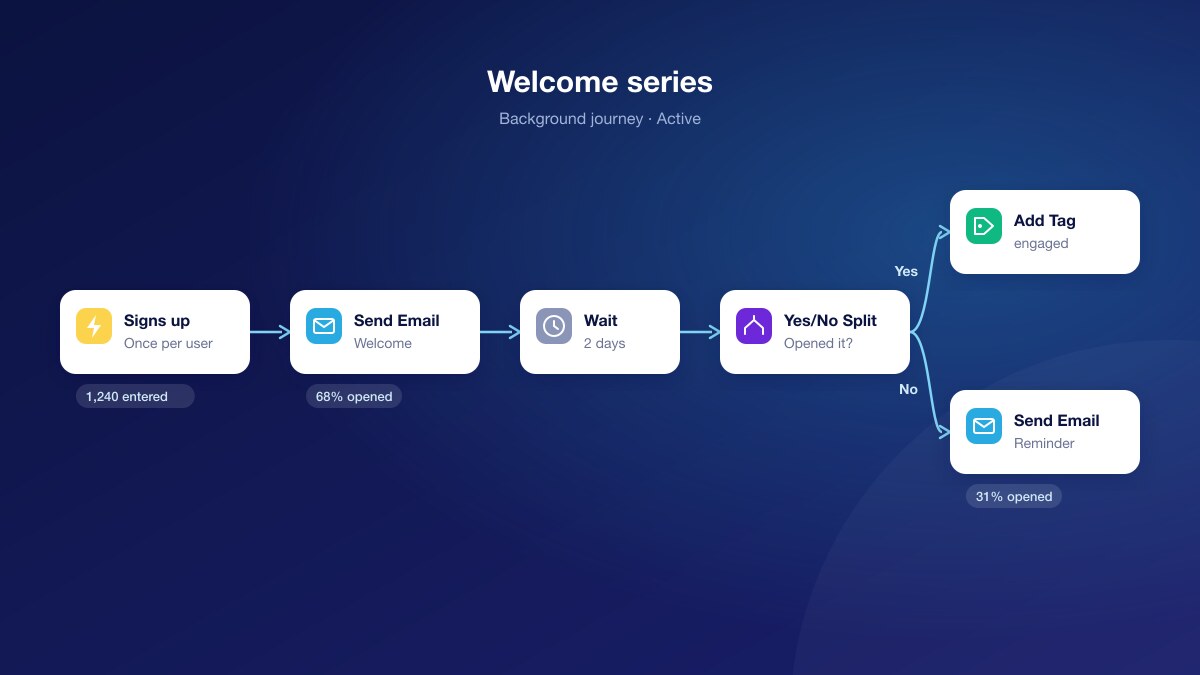
The most useful part of a welcome series is the branch for readers who don't engage. If a reader hasn't opened the welcome email after two days, sending them email 2 as planned is unlikely to work.
Instead, split the series:
- Readers who opened continue to the newsletter email.
- Readers who didn't open get a short reminder with a different subject line and a single story, then rejoin the main series.
Tag the readers who engaged, for example as engaged. That tag is useful far beyond the welcome series: you can build a segment of new readers who are already active and show them a subscription offer on your site sooner.
Timing and Frequency
- Send the first email within minutes of sign-up. Hours later, the reader has moved on.
- Leave at least two days between emails. A welcome series should feel attentive, not pushy.
- Stop the series for readers who subscribe or unsubscribe partway through.
- Only send to readers who agreed to receive marketing email. Everyone else should get the essential account emails only.
Measure the Series
Track three things for each email: open rate, click rate and the share of readers who take the email's one action, such as choosing a newsletter or following a topic. Compare readers who finished the series with those who didn't on how many days they visited in their first month. That is the number a welcome series is meant to move.
If one email underperforms, test a new version against it. A random split sends half the readers each version, so you can see which one gets more opens and clicks before switching everyone over.
Build It with UniSignIn
With Journeys you build the whole series as one flow: the sign-up starts it, each email uses one of your email templates, waits space them out, and a Yes/No split checks whether the welcome email was opened. Tags and profile updates feed your segments, and each step shows how many readers reached it and how many opened and clicked.
For a step-by-step guide, see Send a welcome email series.
Everything you need
All-in-one platform
UniSignIn is all-in-one first-party data platform to collect and manage the first-party data of your digital assets.
- Social Login with Google Login
- Social Login with Facebook Login
- Social Login with Twitter Login
- First-party data analysis
- First-party data onboarding and management
- Single Sign-On with Email and password
- User experience orchestration engine
- Personalised Email and communication
- First-party data collector
- First-party tag management
Stay ahead in first-party data
Identity, consent, audience, and subscription insights for publishers. A few emails a month, no spam.